Kosača (ród): Różnice pomiędzy wersjami
(Utworzono nową stronę "Kategoria:1ra https://en.wikipedia.org/wiki/Kosa%C4%8Da_noble_family") |
|||
| Linia 1: | Linia 1: | ||
[[Kategoria:1ra]] | [[Kategoria:1ra]] | ||
| + | [[Kategoria:Strony przetłumaczone z angielskiej Wikipedii]] | ||
| + | {{Uwaga| | ||
| + | |strona = https://en.wikipedia.org/wiki/Kosa%C4%8Da_noble_family | ||
| + | |autorzy = https://en.wikipedia.org/w/index.php?title=Kosa%C4%8Da_noble_family&action=history | ||
| + | |nota = angielski | ||
| + | }} | ||
| − | https://en.wikipedia.org/wiki/ | + | {| |
| + | | | ||
| + | |} | ||
| + | |||
| + | {| | ||
| + | |-style="vertical-align:top;" | ||
| + | | | ||
| + | |||
| + | {{Redirect|Kosače|a village|Kosače (Goražde)}} | ||
| + | {{Infobox noble house | ||
| + | | surname = Kosača | ||
| + | | type = <!-- Royal house, noble house, etc. --> | ||
| + | | native_name = Косача | ||
| + | | native_name_lang = bs | ||
| + | | other_name = Kosačić<br>Косачић | ||
| + | | coat of arms = Kosačegrb.png | ||
| + | | country = | ||
| + | *Vassal to {{flagicon|Serbian Empire}} [[Kingdom of Serbia (medieval)|Serbian Kingdom]]/[[Serbian Empire|Empire]] (ca. 1331–1359) | ||
| + | *Vassal to [[Kingdom of Bosnia]]<br/>(1388–1415) | ||
| + | *Vassal to {{flag|Ottoman Empire}}<br/>(1415–1444, 1469–1480) | ||
| + | *Vassal to {{flagicon image|Siñal d'Aragón.svg}} [[Kingdom of Aragon]]<br/>(1444–1466) | ||
| + | | estates = | ||
| + | *Gornje [[Podrinje]] or Gornja Drina (area around the upper course of the Drina river) | ||
| + | *[[Zahumlje|Hum]] (1388–1480)<br/>(roughly modern [[Herzegovina]]) | ||
| + | *[[Duchy of Saint Sava]] (1435–1480) | ||
| + | | titles = | ||
| + | *vojvoda | ||
| + | *herceg | ||
| + | *bey<br> | ||
| + | special titles | ||
| + | *[[Grand Duke of Bosnia]] (Veliki Vojvoda Bosanski)<ref name="John Van Antwerp Fine578">{{harvnb|Fine|1994|p=578}}</ref> | ||
| + | *Herzog (''Duke'') of Hum and the Coast<ref name="John Van Antwerp Fine578"/> | ||
| + | *Herzog of Saint Sava | ||
| + | *[[Grand Vizier]] | ||
| + | *[[list of Kapudan Pashas|Grand Admiral]] | ||
| + | | founder = [[Vuk Kosača]] | ||
| + | | final ruler = [[Vlatko Hercegović]] | ||
| + | | founding year = first half of the 14th century | ||
| + | | dissolution = 1483 | ||
| + | | ethnicity = [[Bosnian]] | ||
| + | | cadet branches = | ||
| + | *Hercegović | ||
| + | *Hersekzade | ||
| + | *Isabegović<ref>{{Citation |last= Emecen |first= Ferıdun ||title= Ishak bey - Osmanlı uç beyi |year=2000 |publisher= TDV İslâm Ansiklopedisi|page= 524| |location= Istanbul|language= Turkish | |quote= Hıristiyan bir aileye mensup olup Bosnalı aristokrat ailelerden Kosac ve Pavlovicler’le akrabalığından söz edilir }}</ref><ref>{{Citation |last= Gökbilgin |first= Tayyib ||title= Edirne Ve Pasha Livasi |year=1952 |publisher= İstanbul Üniversitesı Edebiyat Fakültesi Yayinlarindan No.508 |page= 333| |location= Edirne|language= Turkish | |quote= Ishak beyın, Isa bezden başka, Mehmed Bey ve Hüsvın Bey adında ıkı oğlu daha olduğu ve babasının da Koç Bey ısmınde bırı bulunduğu, Fatıh devrıne aıt ıkı vesıkadan anlaşılmaktadır (krş. Alı Emırı tasnıfıö Fatıh, n. 23,26). Başlıkları şöyledır}}</ref><ref>{{Citation |last= Emecen |first= Ferıdun ||title= Ishak bey - Osmanlı uç beyi |year=2000 |publisher= TDV İslâm Ansiklopedisi|page= 524,525| |location= Istanbul|language= Turkish | |quote= "Kosac" ile "Koç" lakabının benzerliği böyle bir irtıbatın bulunabileceği ihtımalini ortaya koyarsa da burada adı geçen şahsın uç beyi İshak’la ilgisi şüphelidir }}</ref><ref>{{Citation |last= Truhelka |first= Dr. Ćiro ||title= Tursko-slovjenski spomenici dubrovačke arhive |year=1911 |publisher= Glasnik Zemaljskog muzeja BiH XXIII.|page= 446| |location= Sarajevo|language= Bosnian | |quote= Mehmedbega Isabegovića, novog sandžaka krajišnika, karakteriše dragoman Skenderbeg u spomenutom pismu ovako: „a tai sadašni sandžak Esebegovik krotak je človek, kako no za Sinanbega. Na nega da se nešto vele ne tratíte i ne spenžate, nego što mu je zákon od pregašneh vrjemeni. S nim je lasno. Takoj da znáte.“ I to malo riječi je u doba, kada bakšiš u turskoj carevini postaje glavnim državničkim načelom, najbolja pohvala državniku. Ovaj sandžak bio je sin glasovitog Isabega Isabegovića, kóji je pod imenom Mehmed-Čelebije bio gospodar Pavloviča zemlje (1466.—1468.)}}</ref> | ||
| + | *Isabegzade | ||
| + | }} | ||
| + | |||
| + | The '''Kosača''' (Cyrillic: Косача, {{small|[[plural|pl.]]}} Kosače / Косаче), somewhere '''Kosačić''' (Косачић, {{small|[[plural|pl.]]}} Kosačići / Косачићи), cadet branch house of [[Kőszegi family]] named Herceg, was a Bosnian<ref>{{Citation | title= State Archives of Dubrovnik, 12.04.1437. Diversa Notariae, XXI, 132|year=1437 | |location= Dubrovnik|language= Latin | |quote= ... Nobiles et egregii viri ser Ivan Vochovich et ser Giurag Radivoy Stipchovich ambo Bosinenses et attinentes condam voivode Sandagl ex quatuor domibus attinentium eiusdem voivode...}}</ref><ref>{{Citation | title= State Archives of Dubrovnik, 20.04.1437. Diversa Notariae, XXI, 132|year=1437 | |location= Dubrovnik|language= Latin | |quote= ... Nobiles viri Vlatchus Obradovich, Radossauus Stiepchovch, Radiç Stiepchovich, Sladoe Vochovich et Stipan Dragisich omnes Bosinenses attinentes condam voiuode Sandagl ex quatuor domibus attinentum eisdem voivode...}}</ref> [[medieval]] [[noble family]] which ruled over parts of modern-day [[Bosnia and Herzegovina]], [[Croatia]], [[Montenegro]], and [[Serbia]] between the 14th century and the 15th century. The land they controlled was known as [[Zachlumia]], roughly corresponding to modern region of [[Herzegovina]], which itself was derived from the title "Herzog", which [[Stjepan Vukčić Kosača]] adopted in 1448. Besides Zachlumia, they ruled parts of [[Dalmatia]] and [[Rascia (region)|Rascia]]. They were vassals to several states, including the [[Kingdom of Bosnia]] and [[Ottoman Empire]]. | ||
| + | <br> | ||
| + | There is no document or evidence that the family "Kosače" belonged to any confession. They were in contact with the [[Church of Bosnia]], the [[Roman Catholic Church]], the [[Orthodox Church]] and [[Islam]], but it was not recorded that anyone belonged to them. They married women of these confessions, respected their faith and supported them, they even built religious buildings but were not personally believers or practiced any religion. During the fall of the Bosnian Kingdom, the "Kosače" split into three branches: Venetian, Dalmatian and Ottoman. At that moment, these branches are accepting the confessions of the Roman Catholic Church and Islam. | ||
| + | |||
| + | ==History== | ||
| + | [[File:Flag of Kosača.svg|left|150px|thumb|Flag of Kosača family]] | ||
| + | The family name ''Kosača'' was probably taken after the village of [[Kosače (Goražde)|Kosače]] near [[Goražde]], in the [[Upper Drina]] region of eastern Bosnia, where the Kosača family were originally estate owners.<ref>{{cite book|url=https://books.google.com/books?id=1OTYAAAAMAAJ&q=bosnian+kosaca+family+podrinje&dq=bosnian+kosaca+family+podrinje&hl=sv&sa=X&ei=IzD5T5ruL8qQ4gSk37DhBg&redir_esc=y|title=Fenomen "krstjani" u srednjovjekovnoj Bosni i Humu: sbornik radova |first=Franjo |last=Šanjek |date=2005 |isbn=978-9958-9642-5-1 |page=266}}</ref><ref name=RAST1> | ||
| + | Др. Жељко Фајфрић, Београд, 7. децембар 2000, [http://www.rastko.rs/istorija/zfajfric-kotromanici_c.html ''Котроманићи'']: "Како су Санковићи сишли са политичке сцене тако се почела издизати породица Косача. Њихово исходиште јесте негде око Фоче где се налазило село Косач, по коме су, могуће је, добили име. Родоначелник ове породице јесте Вук Косача, али породица захваљује свој успон његовом сину Влатку Вуковићу. Он је био од самог почетка један од најповерљивијих људи краља Твртка I. Ишао је у многе преговоре као његов представник, победио Турке код Билеће 1388. године, водио босанску војску на Косову 1389. године, и још доста тога што га је уздигло у односу на остале. Напад на Санковиће била му је и последња акција будући да је већ следеће године (1392.) умро. Наследио га је Сандаљ Хранић, син његовог брата Храње Вуковића. Осим земаља и утицаја, наследио је Сандаљ од стрица Влатка и титулу војводе. У то прво време Сандаљ Хранић нема одлучујући утицај у Босни, будући да су испред њега Павле Раденовић и Хрвоје Вукчић, али његово је време долазило."</ref> | ||
| + | |||
| + | The founder, [[Vuk Kosača|Vuk]]<ref name=RAST1/> was a prominent military commander under [[Stephen Uroš IV Dušan of Serbia|Emperor Dušan the Mighty of Serbia]] (r. 1331–1359) who took part in the conquests of southern Balkans. He was given lands around Upper Drina, province of [[Rudine (župa)|Rudine]].<ref>Tomović, p. 2</ref><ref>Arheološko društvo Jugoslavije 1968, p. 96</ref> | ||
| + | |||
| + | [[Vlatko Vuković]], the son of Vuk, brought the family to prominence after taking part in battles against the Ottomans.<ref name=RAST1/> He commanded the victorious Bosnian army at the [[Battle of Bileća]] (1388).<ref name=RAST1/> At the [[Battle of Kosovo]] (1389) Bosnian King [[Tvrtko I]] sent him to command with his troops. Bosnian contingent under Vlatko was positioned at the left flank from the Serbian army led by Prince [[Lazar of Serbia]]. The battle was at first reported as a victory, also by Vlatko himself, however it has been concluded as inconclusive, with a long-term Ottoman victory.<ref name="John Van Antwerp Fine409-411">Fine 1994, p. 409–411</ref> | ||
| + | |||
| + | [[Stjepan Vukčić Kosača]] in 1448 dropped his title "''Vojvoda'' of Bosnia", assuming the title "Herceg of Hum and the Coast".<ref name="John Van Antwerp Fine578"/> He changed it again in 1449 to "Herceg of Saint Sava" in recollection of the Serbian Orthodox saint.<ref name="John Van Antwerp Fine578"/> This title had considerable public relations value, because Sava's relics were consider miracle-working by people of all Christian faiths. The Kosačas themselves, however, were one of the few non-Orthodox noble families in Hum.<ref name="John Van Antwerp Fine578"/> His lands were known as Herzog's lands or later [[Herzegovina]].<ref name="John Van Antwerp Fine578"/><ref>The first written document to mention "Herzegovina" is letter from Duke Isa-bey Ishakovic Hranic dated 01/02/1455 recommending to his subordinates his friend out from Dubrovnik merchant Franko to take him wherever he goes, to Pavlovic country, to Moravica or to Herzegovina | ||
| + | It is written in "Bosancica" | ||
| + | Source: State Archives of Dubrovnik, Historical letter out of Isa bey Ishakovic from 01.02.1455. </ref> | ||
| + | |||
| + | |||
| + | King [[Stjepan Tomaš]] of Bosnia married [[Katarina Kosača]], daughter of Stjepan Vukčić, in a Catholic ceremony in May 1446 ensuring, at least for a short while, he had the support of the most powerful nobleman in the kingdom and a staunch supporter of the [[Bosnian Church]], [[Stjepan Vukčić Kosača|Stjepan Vukčić]].<ref name="miller-1921">{{cite book | url = https://archive.org/details/in.ernet.dli.2015.533390 | title = Essays on the Latin Orient | publisher = CUP Archive | pages = [https://archive.org/details/in.ernet.dli.2015.533390/page/n527 508]–509 | year = 1921 | last = Miller | first = William | authorlink= William Miller (historian) | accessdate = 2011-02-26}}</ref> | ||
| + | |||
| + | ==Members== | ||
| + | [[File:Грб Вуковића.png|thumb|120px|Coat of Arms of the "Vuković", from the [[Fojnica Armorial]] (18th century).]] | ||
| + | *[[Vuk Kosača]], military commander (''voivode'') | ||
| + | :*[[Vlatko Vuković]], ''[[Grand Duke of Bosnia]]'', died 1392 | ||
| + | :*[[Hrana Vuković]] | ||
| + | ::*[[Sandalj Hranić]], ''Grand Duke of Bosnia'', ca 1392–1435 | ||
| + | ::*[[Vuk Hranić]], ''[[knyaz]]'' in the Bosnian court | ||
| + | :::*Ivan Vuković, ''prince'' | ||
| + | ::::*Adam Vuković | ||
| + | ::*[[Vukac Hranić]], ''knyaz'' in the Bosnian court | ||
| + | :::*[[Stjepan Vukčić|Stjepan Vukčić Kosača]], ''Grand Duke of Bosnia'' 1435–1456, later ''Duke of Saint Sava'', 1456–1466 | ||
| + | ::::*[[Vladislav Hercegović]], ''Duke of Saint Sava'', 1466–1483 | ||
| + | <!-- :::::*Petar Balša | ||
| + | ::::::*Matija | ||
| + | :::::::*Nikola (Niklos) Balša | ||
| + | ::::::::*Georgije | ||
| + | ::::::::*Pavle | ||
| + | ::::::::*Stefan | ||
| + | ::::::::*Katarina | ||
| + | ::::::::*Marija | ||
| + | :::::::*Unknown Daughter | ||
| + | ::::::*Vladislav --> | ||
| + | ::::*[[Vlatko Hercegović]] | ||
| + | <!-- :::::*Marija | ||
| + | :::::*Jovan | ||
| + | ::::::*Sava | ||
| + | ::::::*Ferante | ||
| + | :::::::*Fernandin | ||
| + | :::::::*Olympia | ||
| + | ::::::*Florence | ||
| + | ::::::*Unknown daughter | ||
| + | ::::::*Vlatko III | ||
| + | :::::::*Alphonse Sandalj | ||
| + | :::::::*Silvije | ||
| + | :::::::*Hector | ||
| + | :::::::*Unknown son | ||
| + | :::::::*Jovan II | ||
| + | ::::::::*Marija | ||
| + | ::::::::*Vlatko IV | ||
| + | :::::::::*Elizabeta | ||
| + | :::::::*Stefan V | ||
| + | :::::::*Merkurije | ||
| + | :::::::*Horacije | ||
| + | ::::::*Stefan III | ||
| + | ::::::*Stefan IV | ||
| + | ::::::*Elizabeth | ||
| + | ::::::*Unknown daughter | ||
| + | ::::::*Unknown daughter --> | ||
| + | ::::*[[Hersekli Ahmed Pasa|Stjepan Hercegović]], later Ahmed-paša Hercegović ({{lang-tr|Hersekli Ahmed-Pasa}}), [[Ottoman Empire|Ottoman]] [[Grand Vizier]], married to Hundi Hatun, the daughter of [[Sultan Bayezid II]] | ||
| + | ::::*Mara Hercegović | ||
| + | ::::*[[Katarina Kosača-Kotromanić]], ''Queen consort of Bosnia'' - wife of [[Stjepan Tomaš]], King of Bosnia | ||
| + | :::::*Sigismund (Šimun) Kotromanić, later converted to Islam and changed his name to Isak-beg Kraljević ({{lang-tr|[[Ishak-bey Kraloglu]]}}) | ||
| + | :::::*Katarina Kotromanić, later she converted to Islam and changed her name to Tahiri-hanuma, buried in Skopje in "turbe" (mausoleum) | ||
| + | <!-- :::*Teodora Vukčić --> | ||
| + | |||
| + | ==Religious legacy== | ||
| + | |||
| + | ===Orthodox=== | ||
| + | Some Eastern Orthodox buildings that were built by Kosača's: | ||
| + | * [[:sh:Manastir Zagra%C4%91e|Zagrađe Monastery]], [[Serbian Orthodox]] monastery built by [[Stjepan Vukčić Kosača]] for his Orthodox wife.<ref>[http://www.idoconline.info/digitalarchive/public/index.cfm?fuseaction=serve&ElementId=491135 Spomenik vladarske kuće Kosača]</ref><ref>[http://www.rsplaneta.com/Vijesti/Republika-Srpska-BiH/5588-O%C4%8Duvanje-ba%C5%A1tine-Hercega-Stefana-Vuk%C4%8Di%C4%87a-Kosa%C4%8De.html Očuvanje baštine Hercega Stefana Vukčića Kosače]{{Dead link|date=February 2020 |bot=InternetArchiveBot |fix-attempted=yes }}</ref> | ||
| + | * Church of Saint Archdeacon Stephen, built by [[Sandalj Hranić]] | ||
| + | * Serbian Orthodox [[Church of Saint George, Sopotnica|Church of Saint George]] in [[Sopotnica (Novo Goražde)|Sopotnica]] near [[Goražde]], founded by Duke Stephen in 1454. The [[Goražde printing house]] worked at this church between 1519 and 1523, producing books in the Serbian recension of [[Church Slavonic]]. | ||
| + | |||
| + | ===Catholic=== | ||
| + | [[Catholics]] from the region often visit Katarina Kosača's tomb in the Roman church of [[Santa Maria in Aracoeli]].<ref name="thynne-1924">{{cite book | url = https://books.google.com/books?id=RUo3AAAAMAAJ&pg=PA154 | title = The churches of Rome | first = Roger | last = Thynne | publisher = K. Paul, Trench, Trubner & co., ltd. | year = 1924 | page = 154 | accessdate = 2011-02-26}}</ref> | ||
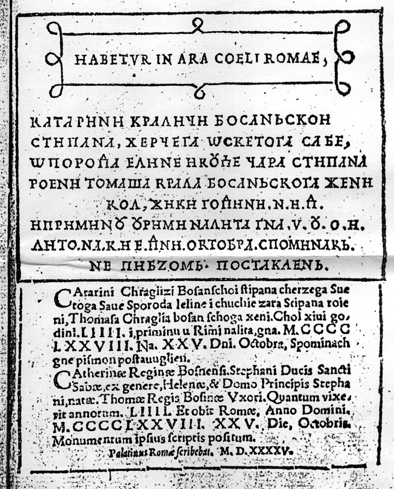
| + | Her tombstone features a life-size portrait and the coat of arms of the [[Kotromanić]]i and Kosača at each side. The inscription, originally written in [[Bosnian Cyrillic]] ([http://www.croatianhistory.net/gif/palat2.jpg Inscription, external link]) but in 1590 replaced with a [[Latin]] one, which reads:<ref name="miller-1921"/> | ||
| + | |||
| + | :{{smallcaps|Catharinae Reginae Bosnensi}} | ||
| + | :{{smallcaps|Stephani ducis santi sabbae sorori}} | ||
| + | :{{smallcaps|et genere Helene et domo principis}} | ||
| + | :{{smallcaps|Stephani natae Thomae regis Bosane}} | ||
| + | :{{smallcaps|vsori Qvanrum vixit annorum LIIII}} | ||
| + | :{{smallcaps|et obdormivit Romae anno Domini}} | ||
| + | :{{smallcaps|MCCCCLXXVIII dei XXV oteobris}} | ||
| + | :{{smallcaps|monumentum ipsus scriptis positiv.}} | ||
| + | |||
| + | The memory of Queen Catherine (Katarina Kosača), who was [[beatified]] after her death, is still alive in Central Bosnia, where [[Catholics]] traditionally mark 25 October with a mass in [[Bobovac]] 'at the altar of the homeland'. Some of the artifacts belonging to the Queen and the [[Kotromanić]] family were taken in 1871 by [[Josip Juraj Strossmayer]] from the [[Franciscan monastery in Kraljeva Sutjeska]] to [[Croatia]] for safekeeping until 'Bosnia is liberated'. They have never been returned. | ||
| + | |||
| + | ===Islam=== | ||
| + | |||
| + | "Turbe" mausoleum in Skopje which was destroyed in the 1963 Skopje earthquake. The mausoleum in memory of Princess Katherine Kotromanić referred in Turkish sources as the "Tahiri-hanuma" was built by [[Isa-Beg Ishaković|Isa beg Ishaković]]. It is a very rare occurrence that a mausoleum is dedicated to a female person. After the quake, the mausoleum of the princess was never restored, but the tradition of the locals has been maintained to this day by visiting and burning candles. | ||
| + | |||
| + | == Przypisy == | ||
| + | {{izvori}} | ||
| + | |||
| + | === Źródła === | ||
| + | * Fine, John Van Antwerp (1994). ''The Late Medieval Balkans: A Critical Survey from the Late Twelfth Century to the Ottoman Conquest''. University of Michigan Press. ISBN 978-0-472-08260-5. ISBN 0-472-08260-4. | ||
| + | * Fine, John Van Antwerp (1975). [https://archive.org/details/bosnianchurchnew0000fine The Bosnian Church: a new interpretation: a study of the Bosnian Church and its place in state and society from the 13th to the 15th centuries]. East European Quarterly. | ||
| + | * Tomović, Gordana. [https://web.archive.org/web/20110726125303/http://www.graduzice.org/userfiles/files/oblasnigospodariu14veku.pdf Oblasni gospodari u 14. veku] (PDF) (po serbo-chorwacku). str. 2. Zarchiwizowane z [http://www.graduzice.org/userfiles/files/oblasnigospodariu14veku.pdf oryginału] (PDF) on 2011-07-26. | ||
| + | * Serbian Patriarchy (1965). ''[https://books.google.com/?id=_ujjAAAAMAAJ Serbian Orthodox Church: its past and present]''. | ||
| + | * Pavle Ivić (1995). [https://books.google.com/?id=7nItAQAAIAAJ The history of Serbian culture]. Porthill Publishers. | ||
| + | * Lukovic. [http://www.balkaninstitut.com/pdf/izdanja/balcanica/balcanica%2035/06%20Lukovic.pdf Заједничка граница области Косача и области Бранковића јужно од реке] (PDF). Balcanica (po serbsku). | ||
| + | * Arheološko društvo Jugoslavije (1968). ''[https://books.google.com/?id=Ym8rAAAAIAAJ Arheološki pregled]'' (po serbo-chorwacku). 10-11. str. 96. | ||
| + | * Др. Жељко Фајфрић (7 grudnia 2000). [http://www.rastko.rs/istorija/zfajfric-kotromanici_c.html Котроманићи] (po serbsku). Београд. | ||
| + | * А. Ивић: [https://en.wikisource.org/wiki/%D0%A0%D0%BE%D0%B4%D0%BE%D1%81%D0%BB%D0%BE%D0%B2%D0%BD%D0%B5_%D1%82%D0%B0%D0%B1%D0%BB%D0%B8%D1%86%D0%B5_(%D0%90._%D0%98%D0%B2%D0%B8%D1%9B) Родословне таблице српских династија и властеле], Нови Сад 1928. | ||
| + | * Дио Сандаљевог депозита за побочну грану племена Косача, У: Српска проза данас : Косаче оснивачи Херцеговине / Ћоровићеви сусрети прозних писаца у Билећи, Научни скуп историчара у Гацку ; [приређивач Радослав Братић]. - Билећа : Просвјета ; Гацко : Просвјета ; Београд : Фонд "Светозар и Владимир Ћоровић", 2002, 261-268. | ||
| + | * Родоначелник племена Косача – војвода Влатко Вуковић, У: Српска проза данас : Косаче оснивачи Херцеговине / Ћоровићеви сусрети прозних писаца у Билећи. Научни скуп историчара у Гацку / [приређивач Радослав Братић]. - Билећа : Просвјета ; Гацко : Просвјета ; Београд : Фонд “Светозар и Владимир Ћоровић”, 2002, 243-260. | ||
| + | * Споредна грана племена Косача, У: Зборник за историју Босне и Херцеговине 3 (2002) 61-77. | ||
| + | * Учешће Косача у ослобађању Јајца од Турака 1463. године, У: Српска проза данас : Косаче оснивачи Херцеговине / Ћоровићеви сусрети прозних писаца у Билећи, Научни скуп историчара у Гацку / [приређивач Радослав Братић]. - Билећа: Просвјета; Гацко: Просвјета; Београд: Фонд "Светозар и Владимир Ћоровић", 2002, 464-475. | ||
| + | |||
| + | * Prof. Dr. Feridun Emecen, [https://en.wikipedia.org/wiki/%C4%B0sl%C3%A2m_Ansiklopedisi TDV İslâm Ansiklopedisi], Turecka encyklopedia naukowa dla studiów islamskich, str. 524,525 | ||
| + | * Prof. Tayyib Gökbilgin, Edirne ve Paşa Livası, Istanbul 1952. str. 333-334 | ||
| + | * Dr. Ćiro Truhelka, Tursko-slovjenski spomenici dubrovačke arhive, Glasnik Zemaljskog muzeja BiH XXIII. 1911. Sarajevo str. 437-484 | ||
| + | |||
| + | |||
| + | {{SORTUJ:Kosaca}} | ||
| + | |||
| + | [[Kategoria:Kosača]] | ||
| + | [[Kategoria:Dynasta | ||
| + | [[Kategoria:Królestwo Bośni]] | ||
Wersja z 14:02, 12 cze 2020
| Strona | Autorzy | Nota |
| [1] | [2] | Ten artykuł został przetłumaczony z Wikipedii w języku angielskim. Treści pochodzące z Wikipedii w języku angielskim są oparte na licencji Creative Commons 3.0 – Uznanie Autorstwa – Na tych samych warunkach. Kopiując je lub tłumacząc, należy podać ich autorów i udostępnić na tych samych warunkach. |
The Kosača (Cyrillic: Косача, pl. Kosače / Косаче), somewhere Kosačić (Косачић, pl. Kosačići / Косачићи), cadet branch house of Kőszegi family named Herceg, was a Bosnian[6][7] medieval noble family which ruled over parts of modern-day Bosnia and Herzegovina, Croatia, Montenegro, and Serbia between the 14th century and the 15th century. The land they controlled was known as Zachlumia, roughly corresponding to modern region of Herzegovina, which itself was derived from the title "Herzog", which Stjepan Vukčić Kosača adopted in 1448. Besides Zachlumia, they ruled parts of Dalmatia and Rascia. They were vassals to several states, including the Kingdom of Bosnia and Ottoman Empire.
Spis treściHistoryPlik:Flag of Kosača.svg Flag of Kosača family The family name Kosača was probably taken after the village of Kosače near Goražde, in the Upper Drina region of eastern Bosnia, where the Kosača family were originally estate owners.[8][9] The founder, Vuk[9] was a prominent military commander under Emperor Dušan the Mighty of Serbia (r. 1331–1359) who took part in the conquests of southern Balkans. He was given lands around Upper Drina, province of Rudine.[10][11] Vlatko Vuković, the son of Vuk, brought the family to prominence after taking part in battles against the Ottomans.[9] He commanded the victorious Bosnian army at the Battle of Bileća (1388).[9] At the Battle of Kosovo (1389) Bosnian King Tvrtko I sent him to command with his troops. Bosnian contingent under Vlatko was positioned at the left flank from the Serbian army led by Prince Lazar of Serbia. The battle was at first reported as a victory, also by Vlatko himself, however it has been concluded as inconclusive, with a long-term Ottoman victory.[12] Stjepan Vukčić Kosača in 1448 dropped his title "Vojvoda of Bosnia", assuming the title "Herceg of Hum and the Coast".[1] He changed it again in 1449 to "Herceg of Saint Sava" in recollection of the Serbian Orthodox saint.[1] This title had considerable public relations value, because Sava's relics were consider miracle-working by people of all Christian faiths. The Kosačas themselves, however, were one of the few non-Orthodox noble families in Hum.[1] His lands were known as Herzog's lands or later Herzegovina.[1][13]
MembersPlik:Грб Вуковића.png Coat of Arms of the "Vuković", from the Fojnica Armorial (18th century).
Religious legacyOrthodoxSome Eastern Orthodox buildings that were built by Kosača's:
CatholicCatholics from the region often visit Katarina Kosača's tomb in the Roman church of Santa Maria in Aracoeli.[17] Her tombstone features a life-size portrait and the coat of arms of the Kotromanići and Kosača at each side. The inscription, originally written in Bosnian Cyrillic (Inscription, external link) but in 1590 replaced with a Latin one, which reads:[14]
The memory of Queen Catherine (Katarina Kosača), who was beatified after her death, is still alive in Central Bosnia, where Catholics traditionally mark 25 October with a mass in Bobovac 'at the altar of the homeland'. Some of the artifacts belonging to the Queen and the Kotromanić family were taken in 1871 by Josip Juraj Strossmayer from the Franciscan monastery in Kraljeva Sutjeska to Croatia for safekeeping until 'Bosnia is liberated'. They have never been returned. Islam"Turbe" mausoleum in Skopje which was destroyed in the 1963 Skopje earthquake. The mausoleum in memory of Princess Katherine Kotromanić referred in Turkish sources as the "Tahiri-hanuma" was built by Isa beg Ishaković. It is a very rare occurrence that a mausoleum is dedicated to a female person. After the quake, the mausoleum of the princess was never restored, but the tradition of the locals has been maintained to this day by visiting and burning candles. Przypisy
Źródła
[[Kategoria:Dynasta |
||||||||||||||||||||||||||||||||||||||||||||||||||||||||||||||||||||||