Kosača (ród): Różnice pomiędzy wersjami
| Linia 20: | Linia 20: | ||
| type = <!-- Royal house, noble house, etc. --> | | type = <!-- Royal house, noble house, etc. --> | ||
| native_name = Косача | | native_name = Косача | ||
| − | | native_name_lang = | + | | native_name_lang = bośniacki |
| other_name = Kosačić<br>Косачић | | other_name = Kosačić<br>Косачић | ||
| coat of arms = Kosačegrb.png | | coat of arms = Kosačegrb.png | ||
| − | | caption = | + | | caption = herb dynastii |
| parent house = | | parent house = | ||
| country = | | country = | ||
| − | *Vassal to [[Plik:Flag_of_the_Serbian_Empire,_reconstruction.svg|22px]] [[ | + | *Vassal to [[Plik:Flag_of_the_Serbian_Empire,_reconstruction.svg|22px]] [[Królestwo Serbii]]/[[Serbian Empire|Empire]] (ok.1331–1359) |
| − | *Vassal to [[ | + | *Vassal to [[Królestwo Bośni]]<br/>(1388–1415) |
| − | *Vassal to [[ | + | *Vassal to [[Plik:Flag_of_the_Ottoman_Empire.svg|22px]] [[Imperium Osmańskie]]<br/>(1415–1444, 1469–1480) |
| − | *Vassal to | + | *Vassal to [[Plik:Siñal_d'Aragón.svg|22px]] [[Królestwo Aragonii]]<br/>(1444–1466) |
| estates = | | estates = | ||
| − | *Gornje [[Podrinje]] | + | *Gornje [[Podrinje]] lub Gornja Drina (obszar wokół górnego biegu rzeki Driny) |
| − | *[[Zahumlje|Hum]] (1388–1480)<br/>( | + | *[[Zahumlje|Hum]] (1388–1480)<br/>(z grubsza nowoczesna [[Hercegowina]]) |
| − | *[[ | + | *Księstwo [[Saint Sava]] (1435–1480) |
| titles = | | titles = | ||
*vojvoda | *vojvoda | ||
| Linia 40: | Linia 40: | ||
special titles | special titles | ||
*[[Grand Duke of Bosnia]] (Veliki Vojvoda Bosanski)<ref name="John Van Antwerp Fine578">{{harvnb|Fine|1994|p=578}}</ref> | *[[Grand Duke of Bosnia]] (Veliki Vojvoda Bosanski)<ref name="John Van Antwerp Fine578">{{harvnb|Fine|1994|p=578}}</ref> | ||
| − | *Herzog ('' | + | *Herzog (''Książę'') Hum i Wybżeża<ref name="John Van Antwerp Fine578"/> |
*Herzog of Saint Sava | *Herzog of Saint Sava | ||
| − | *[ | + | *[https://pl.wikipedia.org/wiki/Wielki_wezyr Wielki wezyr]] |
| − | *[ | + | *[https://en.wikipedia.org/wiki/List_of_Kapudan_Pashas Wielki pasza]] |
| styles = | | styles = | ||
| founded = | | founded = | ||
| Linia 49: | Linia 49: | ||
| final ruler = [[Vlatko Hercegović]] | | final ruler = [[Vlatko Hercegović]] | ||
| current head = | | current head = | ||
| − | | founding year = | + | | founding year = pierwsza połowa XIV wieku |
| dissolution = 1483 | | dissolution = 1483 | ||
| deposition = | | deposition = | ||
| − | | ethnicity = [[ | + | | ethnicity = [[bośniackie]] |
| cadet branches = | | cadet branches = | ||
*Hercegović | *Hercegović | ||
Wersja z 14:20, 12 cze 2020
| Strona | Autorzy | Nota |
| [1] | [2] | Ten artykuł został przetłumaczony z Wikipedii w języku angielskim. Treści pochodzące z Wikipedii w języku angielskim są oparte na licencji Creative Commons 3.0 – Uznanie Autorstwa – Na tych samych warunkach. Kopiując je lub tłumacząc, należy podać ich autorów i udostępnić na tych samych warunkach. |
The Kosača (Cyrillic: Косача, pl. Kosače / Косаче), somewhere Kosačić (Косачић, pl. Kosačići / Косачићи), cadet branch house of Kőszegi family named Herceg, was a Bosnian[6][7] medieval noble family which ruled over parts of modern-day Bosnia and Herzegovina, Croatia, Montenegro, and Serbia between the 14th century and the 15th century. The land they controlled was known as Zachlumia, roughly corresponding to modern region of Herzegovina, which itself was derived from the title "Herzog", which Stjepan Vukčić Kosača adopted in 1448. Besides Zachlumia, they ruled parts of Dalmatia and Rascia. They were vassals to several states, including the Kingdom of Bosnia and Ottoman Empire.
Spis treściHistoryPlik:Flag of Kosača.svg Flag of Kosača family The family name Kosača was probably taken after the village of Kosače near Goražde, in the Upper Drina region of eastern Bosnia, where the Kosača family were originally estate owners.[8][9] The founder, Vuk[9] was a prominent military commander under Emperor Dušan the Mighty of Serbia (r. 1331–1359) who took part in the conquests of southern Balkans. He was given lands around Upper Drina, province of Rudine.[10][11] Vlatko Vuković, the son of Vuk, brought the family to prominence after taking part in battles against the Ottomans.[9] He commanded the victorious Bosnian army at the Battle of Bileća (1388).[9] At the Battle of Kosovo (1389) Bosnian King Tvrtko I sent him to command with his troops. Bosnian contingent under Vlatko was positioned at the left flank from the Serbian army led by Prince Lazar of Serbia. The battle was at first reported as a victory, also by Vlatko himself, however it has been concluded as inconclusive, with a long-term Ottoman victory.[12] Stjepan Vukčić Kosača in 1448 dropped his title "Vojvoda of Bosnia", assuming the title "Herceg of Hum and the Coast".[1] He changed it again in 1449 to "Herceg of Saint Sava" in recollection of the Serbian Orthodox saint.[1] This title had considerable public relations value, because Sava's relics were consider miracle-working by people of all Christian faiths. The Kosačas themselves, however, were one of the few non-Orthodox noble families in Hum.[1] His lands were known as Herzog's lands or later Herzegovina.[1][13]
MembersPlik:Грб Вуковића.png Coat of Arms of the "Vuković", from the Fojnica Armorial (18th century).
Religious legacyOrthodoxSome Eastern Orthodox buildings that were built by Kosača's:
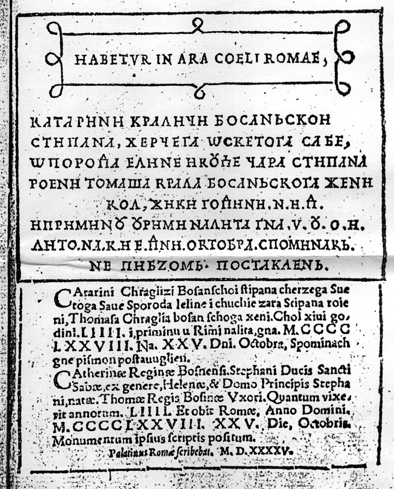
CatholicCatholics from the region often visit Katarina Kosača's tomb in the Roman church of Santa Maria in Aracoeli.[17] Her tombstone features a life-size portrait and the coat of arms of the Kotromanići and Kosača at each side. The inscription, originally written in Bosnian Cyrillic (Inscription, external link) but in 1590 replaced with a Latin one, which reads:[14]
The memory of Queen Catherine (Katarina Kosača), who was beatified after her death, is still alive in Central Bosnia, where Catholics traditionally mark 25 October with a mass in Bobovac 'at the altar of the homeland'. Some of the artifacts belonging to the Queen and the Kotromanić family were taken in 1871 by Josip Juraj Strossmayer from the Franciscan monastery in Kraljeva Sutjeska to Croatia for safekeeping until 'Bosnia is liberated'. They have never been returned. Islam"Turbe" mausoleum in Skopje which was destroyed in the 1963 Skopje earthquake. The mausoleum in memory of Princess Katherine Kotromanić referred in Turkish sources as the "Tahiri-hanuma" was built by Isa beg Ishaković. It is a very rare occurrence that a mausoleum is dedicated to a female person. After the quake, the mausoleum of the princess was never restored, but the tradition of the locals has been maintained to this day by visiting and burning candles. Przypisy
Źródła
[[Kategoria:Dynasta |
||||||||||||||||||||||||||||||||||||||||||||||