| 20px Przekierowanie z Kosače (Goražde).
|
|
|
|
|
| Język
|
bośniacki
|
|
|
| Inne nazwy
|
Kosačić
Косачић
|
herb dynastii
herb dynastii
|
|
|
| Kraj
|
Wasal:
|
|
|
| Posiadłości
|
Ziemie:
|
|
|
| Tytulatura
|
vojvoda, książę, bey
specjalne tytuły:
|
|
|
| Założyciel
|
Vuk Kosača
|
|
|
| Ostatni
|
Vlatko Hercegović
|
|
|
| Koniec
|
1483
|
|
|
| Pochodzenie
|
bośniackie
|
|
|
| Młodsze gałęzie
|
• Hercegović
• Hersekzade
• Isabegović[2][3][4][5]
• Isabegzade
|
The Kosača (Cyrillic: Косача, pl. Kosače / Косаче), somewhere Kosačić (Косачић, pl. Kosačići / Косачићи), cadet branch house of Kőszegi family named Herceg, was a Bosnian[6][7] medieval noble family which ruled over parts of modern-day Bosnia and Herzegovina, Croatia, Montenegro, and Serbia between the 14th century and the 15th century. The land they controlled was known as Zachlumia, roughly corresponding to modern region of Herzegovina, which itself was derived from the title "Herzog", which Stjepan Vukčić Kosača adopted in 1448. Besides Zachlumia, they ruled parts of Dalmatia and Rascia. They were vassals to several states, including the Kingdom of Bosnia and Ottoman Empire.
There is no document or evidence that the family "Kosače" belonged to any confession. They were in contact with the Church of Bosnia, the Roman Catholic Church, the Orthodox Church and Islam, but it was not recorded that anyone belonged to them. They married women of these confessions, respected their faith and supported them, they even built religious buildings but were not personally believers or practiced any religion. During the fall of the Bosnian Kingdom, the "Kosače" split into three branches: Venetian, Dalmatian and Ottoman. At that moment, these branches are accepting the confessions of the Roman Catholic Church and Islam.
History
The family name Kosača was probably taken after the village of Kosače near Goražde, in the Upper Drina region of eastern Bosnia, where the Kosača family were originally estate owners.[8][9]
The founder, Vuk[9] was a prominent military commander under Emperor Dušan the Mighty of Serbia (r. 1331–1359) who took part in the conquests of southern Balkans. He was given lands around Upper Drina, province of Rudine.[10][11]
Vlatko Vuković, the son of Vuk, brought the family to prominence after taking part in battles against the Ottomans.[9] He commanded the victorious Bosnian army at the Battle of Bileća (1388).[9] At the Battle of Kosovo (1389) Bosnian King Tvrtko I sent him to command with his troops. Bosnian contingent under Vlatko was positioned at the left flank from the Serbian army led by Prince Lazar of Serbia. The battle was at first reported as a victory, also by Vlatko himself, however it has been concluded as inconclusive, with a long-term Ottoman victory.[12]
Stjepan Vukčić Kosača in 1448 dropped his title "Vojvoda of Bosnia", assuming the title "Herceg of Hum and the Coast".[1] He changed it again in 1449 to "Herceg of Saint Sava" in recollection of the Serbian Orthodox saint.[1] This title had considerable public relations value, because Sava's relics were consider miracle-working by people of all Christian faiths. The Kosačas themselves, however, were one of the few non-Orthodox noble families in Hum.[1] His lands were known as Herzog's lands or later Herzegovina.[1][13]
King Stjepan Tomaš of Bosnia married Katarina Kosača, daughter of Stjepan Vukčić, in a Catholic ceremony in May 1446 ensuring, at least for a short while, he had the support of the most powerful nobleman in the kingdom and a staunch supporter of the Bosnian Church, Stjepan Vukčić.[14]
Członkowie
-
-
-
-
-
- Sigismund (Šimun) Kotromanić, later converted to Islam and changed his name to Isak-beg Kraljević (Szablon:Lang-tr)
- Katarina Kotromanić, later she converted to Islam and changed her name to Tahiri-hanuma, buried in Skopje in "turbe" (mausoleum)
Religious legacy
Orthodox
Some Eastern Orthodox buildings that were built by Kosača's:
Catholic
Catholics from the region often visit Katarina Kosača's tomb in the Roman church of Santa Maria in Aracoeli.[17]
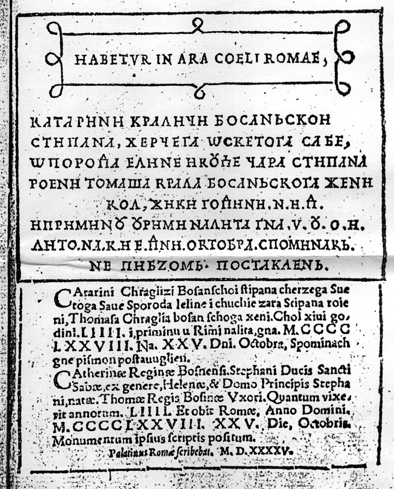
Her tombstone features a life-size portrait and the coat of arms of the Kotromanići and Kosača at each side. The inscription, originally written in Bosnian Cyrillic (Inscription, external link) but in 1590 replaced with a Latin one, which reads:[14]
- <templatestyles src="smallcaps/styles.css"/>Catharinae Reginae Bosnensi
- <templatestyles src="smallcaps/styles.css"/>Stephani ducis santi sabbae sorori
- <templatestyles src="smallcaps/styles.css"/>et genere Helene et domo principis
- <templatestyles src="smallcaps/styles.css"/>Stephani natae Thomae regis Bosane
- <templatestyles src="smallcaps/styles.css"/>vsori Qvanrum vixit annorum LIIII
- <templatestyles src="smallcaps/styles.css"/>et obdormivit Romae anno Domini
- <templatestyles src="smallcaps/styles.css"/>MCCCCLXXVIII dei XXV oteobris
- <templatestyles src="smallcaps/styles.css"/>monumentum ipsus scriptis positiv.
The memory of Queen Catherine (Katarina Kosača), who was beatified after her death, is still alive in Central Bosnia, where Catholics traditionally mark 25 October with a mass in Bobovac 'at the altar of the homeland'. Some of the artifacts belonging to the Queen and the Kotromanić family were taken in 1871 by Josip Juraj Strossmayer from the Franciscan monastery in Kraljeva Sutjeska to Croatia for safekeeping until 'Bosnia is liberated'. They have never been returned.
Islam
"Turbe" mausoleum in Skopje which was destroyed in the 1963 Skopje earthquake. The mausoleum in memory of Princess Katherine Kotromanić referred in Turkish sources as the "Tahiri-hanuma" was built by Isa beg Ishaković. It is a very rare occurrence that a mausoleum is dedicated to a female person. After the quake, the mausoleum of the princess was never restored, but the tradition of the locals has been maintained to this day by visiting and burning candles.
Przypisy
- ↑ 1,0 1,1 1,2 1,3 1,4 1,5
- ↑ {{#invoke:citation/CS1|citation
|CitationClass=citation
}}
- ↑ {{#invoke:citation/CS1|citation
|CitationClass=citation
}}
- ↑ {{#invoke:citation/CS1|citation
|CitationClass=citation
}}
- ↑ {{#invoke:citation/CS1|citation
|CitationClass=citation
}}
- ↑ {{#invoke:citation/CS1|citation
|CitationClass=citation
}}
- ↑ {{#invoke:citation/CS1|citation
|CitationClass=citation
}}
- ↑ Šanjek, Franjo (2005). Fenomen "krstjani" u srednjovjekovnoj Bosni i Humu: sbornik radova. str. 266. ISBN 978-9958-9642-5-1. https://books.google.com/books?id=1OTYAAAAMAAJ&q=bosnian+kosaca+family+podrinje&dq=bosnian+kosaca+family+podrinje&hl=sv&sa=X&ei=IzD5T5ruL8qQ4gSk37DhBg&redir_esc=y.
- ↑ 9,0 9,1 9,2 9,3
Др. Жељко Фајфрић, Београд, 7. децембар 2000, Котроманићи: "Како су Санковићи сишли са политичке сцене тако се почела издизати породица Косача. Њихово исходиште јесте негде око Фоче где се налазило село Косач, по коме су, могуће је, добили име. Родоначелник ове породице јесте Вук Косача, али породица захваљује свој успон његовом сину Влатку Вуковићу. Он је био од самог почетка један од најповерљивијих људи краља Твртка I. Ишао је у многе преговоре као његов представник, победио Турке код Билеће 1388. године, водио босанску војску на Косову 1389. године, и још доста тога што га је уздигло у односу на остале. Напад на Санковиће била му је и последња акција будући да је већ следеће године (1392.) умро. Наследио га је Сандаљ Хранић, син његовог брата Храње Вуковића. Осим земаља и утицаја, наследио је Сандаљ од стрица Влатка и титулу војводе. У то прво време Сандаљ Хранић нема одлучујући утицај у Босни, будући да су испред њега Павле Раденовић и Хрвоје Вукчић, али његово је време долазило."
- ↑ Tomović, p. 2
- ↑ Arheološko društvo Jugoslavije 1968, p. 96
- ↑ Fine 1994, p. 409–411
- ↑ The first written document to mention "Herzegovina" is letter from Duke Isa-bey Ishakovic Hranic dated 01/02/1455 recommending to his subordinates his friend out from Dubrovnik merchant Franko to take him wherever he goes, to Pavlovic country, to Moravica or to Herzegovina
It is written in "Bosancica"
Source: State Archives of Dubrovnik, Historical letter out of Isa bey Ishakovic from 01.02.1455.
- ↑ 14,0 14,1 Miller, William (1921). Essays on the Latin Orient. CUP Archive. str. 508–509. https://archive.org/details/in.ernet.dli.2015.533390. Pristupljeno 2011-02-26.
- ↑ Spomenik vladarske kuće Kosača
- ↑ Očuvanje baštine Hercega Stefana Vukčića KosačeSzablon:Dead link
- ↑ Thynne, Roger (1924). The churches of Rome. K. Paul, Trench, Trubner & co., ltd.. str. 154. https://books.google.com/books?id=RUo3AAAAMAAJ&pg=PA154. Pristupljeno 2011-02-26.
Źródła
- Fine, John Van Antwerp (1994). The Late Medieval Balkans: A Critical Survey from the Late Twelfth Century to the Ottoman Conquest. University of Michigan Press. ISBN 978-0-472-08260-5. ISBN 0-472-08260-4.
- Fine, John Van Antwerp (1975). The Bosnian Church: a new interpretation: a study of the Bosnian Church and its place in state and society from the 13th to the 15th centuries. East European Quarterly.
- Tomović, Gordana. Oblasni gospodari u 14. veku (PDF) (po serbo-chorwacku). str. 2. Zarchiwizowane z oryginału (PDF) on 2011-07-26.
- Serbian Patriarchy (1965). Serbian Orthodox Church: its past and present.
- Pavle Ivić (1995). The history of Serbian culture. Porthill Publishers.
- Lukovic. Заједничка граница области Косача и области Бранковића јужно од реке (PDF). Balcanica (po serbsku).
- Arheološko društvo Jugoslavije (1968). Arheološki pregled (po serbo-chorwacku). 10-11. str. 96.
- Др. Жељко Фајфрић (7 grudnia 2000). Котроманићи (po serbsku). Београд.
- А. Ивић: Родословне таблице српских династија и властеле, Нови Сад 1928.
- Дио Сандаљевог депозита за побочну грану племена Косача, У: Српска проза данас : Косаче оснивачи Херцеговине / Ћоровићеви сусрети прозних писаца у Билећи, Научни скуп историчара у Гацку ; [приређивач Радослав Братић]. - Билећа : Просвјета ; Гацко : Просвјета ; Београд : Фонд "Светозар и Владимир Ћоровић", 2002, 261-268.
- Родоначелник племена Косача – војвода Влатко Вуковић, У: Српска проза данас : Косаче оснивачи Херцеговине / Ћоровићеви сусрети прозних писаца у Билећи. Научни скуп историчара у Гацку / [приређивач Радослав Братић]. - Билећа : Просвјета ; Гацко : Просвјета ; Београд : Фонд “Светозар и Владимир Ћоровић”, 2002, 243-260.
- Споредна грана племена Косача, У: Зборник за историју Босне и Херцеговине 3 (2002) 61-77.
- Учешће Косача у ослобађању Јајца од Турака 1463. године, У: Српска проза данас : Косаче оснивачи Херцеговине / Ћоровићеви сусрети прозних писаца у Билећи, Научни скуп историчара у Гацку / [приређивач Радослав Братић]. - Билећа: Просвјета; Гацко: Просвјета; Београд: Фонд "Светозар и Владимир Ћоровић", 2002, 464-475.
- Prof. Dr. Feridun Emecen, TDV İslâm Ansiklopedisi, Turecka encyklopedia naukowa dla studiów islamskich, str. 524,525
- Prof. Tayyib Gökbilgin, Edirne ve Paşa Livası, Istanbul 1952. str. 333-334
- Dr. Ćiro Truhelka, Tursko-slovjenski spomenici dubrovačke arhive, Glasnik Zemaljskog muzeja BiH XXIII. 1911. Sarajevo str. 437-484
[[Kategoria:Dynasta
|