Syrmia: Różnice pomiędzy wersjami
| Linia 38: | Linia 38: | ||
<small><small>The '''Realm of Stefan Dragutin''' (serb. ''Стефана Драгутина'' / ''Oblast Stefana Dragutina'') was a medieval [[Serbs|Serb]] kingdom. Initially, it was a vassal kingdom of the [[Kingdom of Hungary (1000–1301)|Kingdom of Hungary]],{{sfn|Fine|1994|p=220}} but subsequently became an independent kingdom, after the collapse of the central power in the Kingdom of Hungary. It was ruled by the Serbian kings [[Stephen Dragutin of Serbia|Stefan Dragutin]] (1282–1316) and his son [[Stephen Vladislav II of Syrmia|Stefan Vladislav II]] (1316–1325). The kingdom was centered in the region of ''[[Lower Syrmia]]'' (today known as [[Mačva]]) and its first capital was [[Debrc]] (between [[Belgrade]] and [[Šabac]]), while residence of the king was later moved to [[Belgrade]]. </small></small> | <small><small>The '''Realm of Stefan Dragutin''' (serb. ''Стефана Драгутина'' / ''Oblast Stefana Dragutina'') was a medieval [[Serbs|Serb]] kingdom. Initially, it was a vassal kingdom of the [[Kingdom of Hungary (1000–1301)|Kingdom of Hungary]],{{sfn|Fine|1994|p=220}} but subsequently became an independent kingdom, after the collapse of the central power in the Kingdom of Hungary. It was ruled by the Serbian kings [[Stephen Dragutin of Serbia|Stefan Dragutin]] (1282–1316) and his son [[Stephen Vladislav II of Syrmia|Stefan Vladislav II]] (1316–1325). The kingdom was centered in the region of ''[[Lower Syrmia]]'' (today known as [[Mačva]]) and its first capital was [[Debrc]] (between [[Belgrade]] and [[Šabac]]), while residence of the king was later moved to [[Belgrade]]. </small></small> | ||
| − | |||
| − | |||
| − | |||
| − | |||
== Historia == | == Historia == | ||
Wersja z 19:19, 20 maj 2020
| Strona | Autorzy | Nota |
| [1] | [2] | Ten artykuł został przetłumaczony z Wikipedii w języku angielskim. Treści pochodzące z Wikipedii w języku angielskim są oparte na licencji Creative Commons 3.0 – Uznanie Autorstwa – Na tych samych warunkach. Kopiując je lub tłumacząc, należy podać ich autorów i udostępnić na tych samych warunkach. |
| Strona | Autorzy | Nota |
| [3] | [4] | Ten artykuł został przetłumaczony z Wikipedii w języku angielskim. Treści pochodzące z Wikipedii w języku angielskim są oparte na licencji Creative Commons 3.0 – Uznanie Autorstwa – Na tych samych warunkach. Kopiując je lub tłumacząc, należy podać ich autorów i udostępnić na tych samych warunkach. |
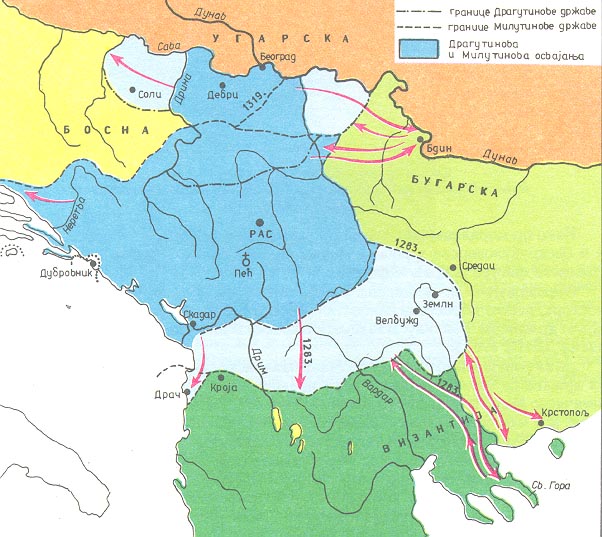
Spis treściTerytoriumPlik:Kingdom of syrmia according to stanoje stanojevic.png Kingdom of Syrmia of Stefan Dragutin with borders that are including Upper Syrmia (according to Serbian historian Stanoje Stanojević) W średniowieczu „Syrmia” była nazwą większego obszaru wokół rzeki Sawy. Część na północy Sawy znana była jako Górna Syrmia (dzisiejsza Syrmia), podczas gdy obszar na południe od rzeki był znany jako Dolna Syrmia (dzisiejsza Machva). Królestwo było skoncentrowane w Mačvie, ale obejmowało także Belgrad, część Sumadija z Rudnikiem oraz powiaty (parafie) Podrinje, Usora, Soli, Branicevo i Kucevo. Według kilku serbskich historyków (Dejan Mikavica, Stanoje Stanojevic, Aleksa Ivic, Milojko Brusin itp.) Królestwo obejmowało także Górną Syrmię (współczesną Syrmię). In the Middle Ages, "Syrmia" was the name for a larger area around the river Sava. The part in the north of Sava was known as Upper Syrmia (present-day Syrmia), while the area south of the river was known as Lower Syrmia (present-day Mačva). The kingdom was centered in Mačva, but also included Belgrade, part of Šumadija with Rudnik, and the counties (župe) of Podrinje, Usora, Soli, Braničevo and Kučevo. According to several Serbian historians (Dejan Mikavica, Stanoje Stanojević, Aleksa Ivić, Milojko Brusin, etc.), the kingdom also included Upper Syrmia (modern Syrmia). GeografiaW średniowieczu „Syrmia” była nazwą większego obszaru wokół rzeki Sawy. Część na północy Sawy znana była jako Górna Syrmia (dzisiejsza Syrmia), podczas gdy obszar na południe od rzeki był znany jako Dolna Syrmia (dzisiejsza Machva). Królestwo było skoncentrowane w Mačvie, ale obejmowało także Belgrad, część Sumadija z Rudnikiem oraz powiaty (parafie) Podrinje, Usora, Soli, Branicevo i Kucevo. Według kilku serbskich historyków (Dejan Mikavica, Stanoje Stanojevic, Aleksa Ivic, Milojko Brusin itp.) Królestwo obejmowało także Górną Syrmię (współczesną Syrmię). The medieval county was situated east of the Laćarak–Susek line, and as it was surrounded by the Danube and Sava rivers, except for in the west, it was regarded an island.{{#invoke:Footnotes|sfn|template=sfn}} The county borders largely correspond to the modern-day Srem District in northwestern Serbia.
Królestwo Stefana Dragutina (serb. Stefan Dragutin / Area of Stefan Dragutin) było średniowiecznym królestwem Serbów. Początkowo było to królestwo wasalne Królestwa Węgier {{# invoke: Footnotes | sfn}}, ale stało się niezależnym królestwem po upadku centralnej władzy w Królestwie Węgier. Rządzili nim serbscy królowie Stefan Dragutin (1282–1316) i jego syn Stefan Władysław II (1316–1325). Królestwo koncentrowało się w regionie Dolnej Syrmii (dziś znanej jako Machva), a jego pierwszą stolicą był Debrc (między Belgradem a Sabakiem), a rezydencja króla została później przeniesiona do Belgradu. The Realm of Stefan Dragutin (serb. Стефана Драгутина / Oblast Stefana Dragutina) was a medieval Serb kingdom. Initially, it was a vassal kingdom of the Kingdom of Hungary,{{#invoke:Footnotes|sfn|template=sfn}} but subsequently became an independent kingdom, after the collapse of the central power in the Kingdom of Hungary. It was ruled by the Serbian kings Stefan Dragutin (1282–1316) and his son Stefan Vladislav II (1316–1325). The kingdom was centered in the region of Lower Syrmia (today known as Mačva) and its first capital was Debrc (between Belgrade and Šabac), while residence of the king was later moved to Belgrade. HistoriaPlik:Koh administrative 1370 01.png Jednostki administracyjne na południu Królestwa Węgier w 1370 r. Syrmia w centrum na niebiesko.
The Theme of Sirmium was taken over by the Hungarians in the late 11th century, and Syrmia became contested between the Byzantines and Hungarians over the century. Manuel I Komnenos retrieved Syrmia in 1162,{{#invoke:Footnotes|sfn|template=sfn}} defended it in 1167,{{#invoke:Footnotes|sfn|template=sfn}} but eventually lost it to Béla III in the 1180s.{{#invoke:Footnotes|sfn|template=sfn}} Its governorship was placed under that of the Banate of Macsó in the 13th century. Do stycznia 1229 r. Hrabstwo Syrmia było w sensie kościelnym podporządkowane jako archidiecezja arcybiskupstwu Kalocsa. [5]} Następnie papież Grzegorz IX zezwolił na ustanowienie nowego biskupstwa z siedzibą w Bánmonostor (współczesny Banoštor). [5] Up until January 1229, the Syrmia County was, in an ecclesiastical sense, subordinated as an archdiocese to the Archbishopric of Kalocsa.{{#invoke:Footnotes|sfn|template=sfn}} Then, Pope Gregory IX permitted the establishment of a new bishopric with seat in Bánmonostor (present-day Banoštor).{{#invoke:Footnotes|sfn|template=sfn}} Po tym, jak serbski władca Stefan Dragutin wszedł w dynastyczne stosunki z Węgrami, otrzymał w 1284 r. Między innymi terytoria, Belgrad i Machwę, co było znane jako front Sirmii w dokumentach papieskich. [5] Dragutin był znany jako „Syrmian king”. [1] Okręg Syrmia był często wymieniany w węgierskich lokatach za panowania Stefana Dragutina w „Syrmii” (1284–1316), jako hrabstwo, w którym królowie nadawali majątki swojej szlachcie . [6] W czasie, gdy okręg syrmia znajdował się pod rządami Serbii, węgierski Karol I był w nim aktywny dwukrotnie, wydając 1 września 1308 r. w Pétervárad (dzisiejszy Petrovaradin), oraz w lutym 1314 roku w Szávaszentdemeter (dzisiejsza Sremska Mitrovica) i Pétervárad. [6] After Serbian ruler Stefan Dragutin entered dynastic relations with Hungary, he received in 1284, among other territories, Belgrade, and Mačva, which was known as ulterior Sirmia in Papal documents.{{#invoke:Footnotes|sfn|template=sfn}} Dragutin was known as the "Syrmian king".{{#invoke:Footnotes|sfn|template=sfn}} The Syrmia County was often mentioned in Hungarian charters during Stefan Dragutin's reign in "Syrmia" (1284–1316), as a county in which the kings gave estates to its nobility.{{#invoke:Footnotes|sfn|template=sfn}} At the time when the Syrmia County was ostensibly under Serbian rule, Charles I of Hungary was active in it twice, issuing charters on 1 September 1308 in Pétervárad (present-day Petrovaradin), and in February 1314 in Szávaszentdemeter (present-day Sremska Mitrovica) and Pétervárad.{{#invoke:Footnotes|sfn|template=sfn}} Syrmia została podbita przez Turków trzy dekady po podbiciu Macsó w 1496 r., Bitwą pod Mohaczami (1526), która doprowadziła do upadku Węgier i panowania osmańskiego w Panonii, a następnie w dalszej Europie. Syrmia was conquered by the Ottomans three decades after their conquest of Macsó in 1496, with the Battle of Mohács (1526) that led to the collapse of Hungary, and Ottoman rule in Pannonia, and subsequently, further into Europe. WładcyThe head of the county was titled ispán (Slavic: župan) — count (comes). See alsoPrzypisyŹródła
HistoriaStefan Dragutin był początkowo królem Serbii od 1276 do 1282. W 1282 złamał nogę podczas polowania i zachorował; przekazał tron swojemu młodszemu bratu Stefanowi Milutinowi podczas soboru w Dieżewie w 1282 r., zachowując dla siebie niektóre północne części kraju (kopalnię i części parafii Podrinje). Ponieważ jego syn Władysław poślubił krewnego króla węgierskiego, Dragutin w 1284 r. Nabył od Władysława IV Banata Só (Soli), orazora (Usora) i Macsó (Mačva) z Belgradem, który początkowo rządził jako wasal węgierski, aż do upadek władzy centralnej w Królestwie Węgier. Pierwszą stolicą jego państwa był Debrc (między Belgradem a Sabacem), a później przeniósł swoją rezydencję do Belgradu. Dragutin był pierwszym serbskim władcą, który rządził z Belgradu jako stolicą. Stefan Dragutin was initially the king of Serbia from 1276 to 1282. In 1282 he broke his leg while hunting and became ill; he passed the throne to his younger brother Stefan Milutin at the council at Deževo in 1282, while keeping for himself some northern parts of the country (Rudnik and parts of Župa of Podrinje). Since his son Vladislav married a relative of the Hungarian king, Dragutin in 1284 gained from Ladislaus IV the Banates of Só (Soli), Ózora (Usora) and Macsó (Mačva) with Belgrade, which he initially ruled as a Hungarian vassal, until the collapse of the central power in the Kingdom of Hungary. The first capital of his state was Debrc (between Belgrade and Šabac), and later he moved his residence to Belgrade. Dragutin was the first Serb ruler who ruled from Belgrade as the capital. Około 1291 r. I przy pomocy Milutina Dragutin rozszerzył swoje terytorium, aneksując regiony Branicevo i Kucevo, których bułgarscy władcy Darman i Kudelin niedawno uniezależnili się od Królestwa Węgier [2]. Po raz pierwszy region ten stał się częścią państwa serbskiego [1]. Ta akcja prawdopodobnie spowodowała wojnę między bułgarskim despotą Shishmanem z Vidin i Milutin. In roughly 1291 and with the help of Milutin, Dragutin expanded his territory by annexing regions of Braničevo and Kučevo, whose Bulgarian rulers Darman and Kudelin recently became independent from the Kingdom of Hungary.[1] For the first time, that region became part of the Serbian state.{{#invoke:Footnotes|sfn|template=sfn}} This action probably caused the war between the Bulgarian despot Shishman of Vidin and Milutin. Pod koniec życia Stefan Dragutin oddzielił się od węgierskich przyjaciół i zacieśnił kontakty w Serbii. Później złożył śluby zakonne i zmarł w 1316 r., Pochowany w klasztorze filarów Đurđevi w pobliżu Novi Pazar. Near the end of his life Stefan Dragutin separated from his Hungarian friends and strengthened his connections in Serbia. He later took monastic vows, and died 1316, buried at the Đurđevi stupovi monastery near Novi Pazar. Po śmierci króla Dragutina jego syn Władysław objął aportaż ojca. Jednak w 1319 r. Serbski król Milutin, wujek Władysława, zaatakował, pokonał i uwięził Władysława. Kiedy Milutin zmarł w 1321 r., Nowo uwolniony Władysław odzyskał ziemie ojca, korzystając z pomocy Węgrów i Szczepana II, Bośni i Hercegowiny [B]. After king Dragutin died, his son Vladislav assumed his father's appanage. However, in 1319, Serbian king Milutin, Vladislav's uncle, invaded, defeated and imprisoned Vladislav. When Milutin died in 1321, the newly freed Vladislav recovered his father's lands, with the help of the Hungarians and Stephen II, Ban of Bosnia.Szablon:Cref2 Po ponownym pobiciu przez zwolenników Stefana Dečańskiego (następcy Milutina) Władysław wycofał się do Królestwa Węgier w 1324 r. Siostrzeniec Władysława, Ban Stephen II, ponownie wcielił Soli i Usorę do Bośni. Belgrad i północna część Banat Macsó wzdłuż rzeki Sawy pozostały pod rządami Królestwa Węgier, natomiast Branicevo i południowa część Macvy pozostały Serbami. Królestwa Serbii i Węgier będą walczyć o miecz na następny wiek. After having been beaten again by supporters of Stefan Dečanski (successor of Milutin), Vladislav retreated to the Kingdom of Hungary in 1324. Vladislav's nephew, Ban Stephen II, reincorporated Soli and Usora into Bosnia. Belgrade and the northern part of Banate of Macsó along the river Sava remained under the rule of the Kingdom of Hungary, while Braničevo and the southern part of Mačva remained Serbian. The kingdoms of Serbia and Hungary would contest Mačva for the next century. Rulers
AnnotationsSzablon:Cnote2 Begin Szablon:Cnote2 Szablon:Cnote2 Szablon:Cnote2 End Prypisy
Źródła
Linki zewnętrzne
|
| |||||||||||||||||||||||||||||||||||||||||||||||||||||||